Guide / Project synthesis, Source-control record, Scholarly interpretation
What Is Himavanta?
Himavanta is a sacred mountain, forest, and water world in Buddhist and related Asian traditions. It is better understood as a long-lived evidence stream than as one fixed fantasy map.
What this page establishes: The durable core is a remote and potent mountain-water world; the details of lakes, rivers, beings, measurements, and directions change by source, period, and medium.
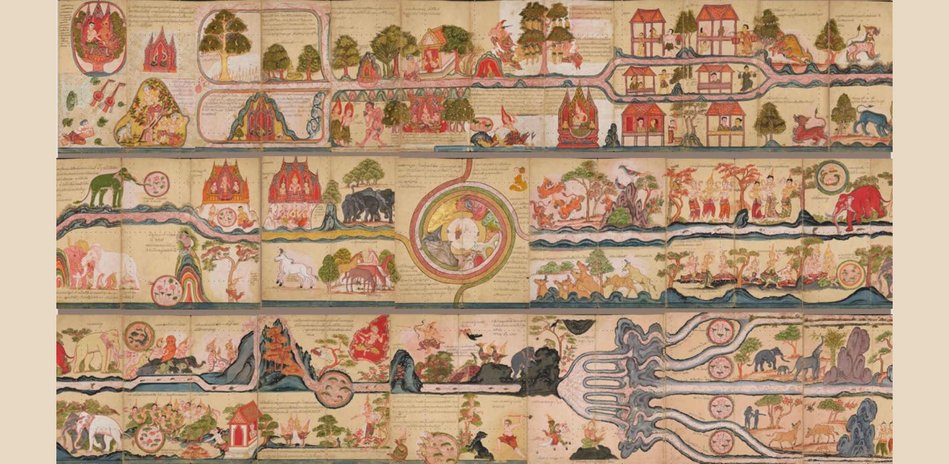
The simplest honest definition
Himavanta is not just a forest of mythical animals, and it is not simply the modern Himalayas under another name. In the reviewed material, it behaves as a charged region where mountains, wilderness, sacred water, nonhuman beings, narrative memory, and cosmographic order meet.
That is why popular descriptions feel unstable. One source may use Himavanta as a broad mountain region, another as a narrative setting, another as the environment around Anotatta or Anavatapta, and later Thai visual culture may turn the same inheritance into a spectacular populated field.
Why there are many versions
The project deliberately freezes each textual or visual family before comparison. Early Pali commentary, Jataka narrative geography, Sanskrit and northern Buddhist Anavatapta traditions, Chinese reconstruction, Khmer water architecture, Thai Traiphum cosmography, and later court bestiary systems do not all say the same thing.
A responsible public guide should not hide that disagreement. The disagreement is the history. The visitor should be able to see which details are old, which are later, which are visual, which are quoted from another source, and which are modern reconstructions.
- Do not average source-specific maps into one master map.
- Do not turn a later Thai visual motif into an early Pali fact.
- Do not treat silence as failure; silence is part of the evidence.
The thread that survives
Across the histories, Himavanta keeps returning as a threshold world: remote from ordinary human access, rich in water and living beings, linked to powerful narratives, and repeatedly useful for explaining sacred geography.
That thread is strong enough to explain continuity without pretending that every witness preserves one unchanged diagram. Himavanta is best presented as a layered tradition with a recognizable center of gravity.
Evidence notes
- The early Pali record is sparse and contextual, not a full atlas.
- The medieval Saratthadipani supplies a connected dossier, but it is later and compilational.
- Thai manuscript images are powerful visual witnesses, not proof that every earlier text contained the same arrangement.
Sources and boundaries
This page gives the public orientation. It is not a claim that Himavanta has one recoverable physical layout.
-
Project synthesis
Himavanta cross-history research archive
histories/ plus history-09 gate records; source families frozen independently
Used only as a synthesis layer. It cannot promote a later witness into an earlier source family.
-
Source-control record
Samantapasadika Gate 1 and Gate 2 records
History 1 controlled extraction; History 5 comparison boundary
Separates main text, explicit quotation, apparatus, false positives, and later subcommentarial material.
-
Source-control record
Indic and northern Buddhist Anavatapta witnesses
History 3 Run 1: S01, S03, S07
Keeps differing dimensions, Gandhamadana relations, river statements, and naga claims separate.
-
Scholarly interpretation
Martina Stoye and Panarut Rungrueng, "In den seligen Gefilden des Himavanta"
Open-access article with Berlin Traiphum manuscript images
Supports the public use of the Berlin manuscript images as a bounded visual witness.