Guide / Project synthesis, Scholarly interpretation, Historical object
Thai Himmapan Creatures: A Visual Guide
Thai Himmapan creatures are a later and highly visible bestiary tradition. Their names, bodies, habitats, and ritual lives need provenance, not just aesthetic labels.
What this page establishes: The creature catalogue is strongest when it is treated as dated visual and ritual culture, not as a timeless list projected backward into every Buddhist source.
The popular doorway
Most visitors will arrive through creatures: naga, garuda, kinnari, hamsa, lion-elephant composites, fish-dragons, and royal or funerary forms. That is useful. The bestiary is visually magnetic and search-friendly.
The danger is that a popular creature page can make the whole tradition look like fantasy taxonomy. The stronger approach is to show morphology, medium, period, and confidence together.
What provenance changes
A creature record can ask simple questions: Is the being named in a text? Is the body form visible in an image? Is the form part of a later Thai court or architectural taxonomy? Does a ritual context change its meaning?
This lets the site welcome artists and mythology readers while still protecting the research. A visitor can enjoy the creature without being misled about where its details come from.
How the finder should be used
The launch finder is an index, not an encyclopedia. It sorts selected records by head, body, wings, habitat, tradition, and evidence status. Provenance-controlled records have stronger anchors; index-controlled records are deliberately limited until deeper source review is complete.
That is still useful for visitors because it tells them what not to overclaim.
Evidence notes
- Modern familiarity is not evidence of early textual presence.
- Morphology is useful but not sufficient without period and medium.
- The creature finder should surface uncertainty instead of hiding it.
Sources and boundaries
The launch index is selected and controlled. It is not a complete taxonomy of all Himmapan creatures.
-
Project synthesis
Himavanta cross-history research archive
histories/ plus history-09 gate records; source families frozen independently
Used only as a synthesis layer. It cannot promote a later witness into an earlier source family.
-
Scholarly interpretation
Martina Stoye and Panarut Rungrueng, "In den seligen Gefilden des Himavanta"
Open-access article with Berlin Traiphum manuscript images
Supports the public use of the Berlin manuscript images as a bounded visual witness.
-
Historical object
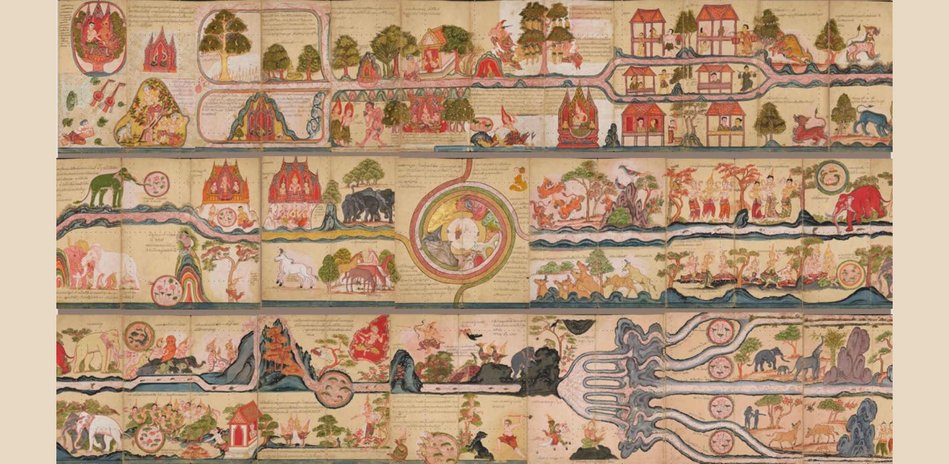
Staatliche Museen zu Berlin, Museum fuer Asiatische Kunst, six-metre Traiphum research page
Direct public manuscript image records used by this site
The images are treated as late Thai visual evidence, not as automatic proof for all earlier textual traditions.