Source-led guide
Kinnari / Kinnara
Pāli narrative, Chinese, and Thai visual traditions
Kinnari / Kinnara is recorded here as human-bird beings whose named settings shift across stories, translations, and later thai art. Its current status is source-led guide: the page distinguishes a source-led guide from a later visual-index identification rather than inventing an ancient universal biography.

What this page does
One source family at a time
This guide links each major assertion to a named source and a boundary. It is designed to be useful for readers, artists, teachers, and researchers without pretending that later images can repair earlier silence.
A human-bird form with many homes
Kinnari and Kinnara are recognizable Himmapan figures. Yet their locations are not one stable forest biome. The archive records Canda Mountain, an upstream Gandhamādana route, Chinese Fragrant Mountain, and a Berlin Kelāsa scene.
Variation is not a defect in the tradition. It maps how stories and images moved through languages and regions.
What the Thai image shows
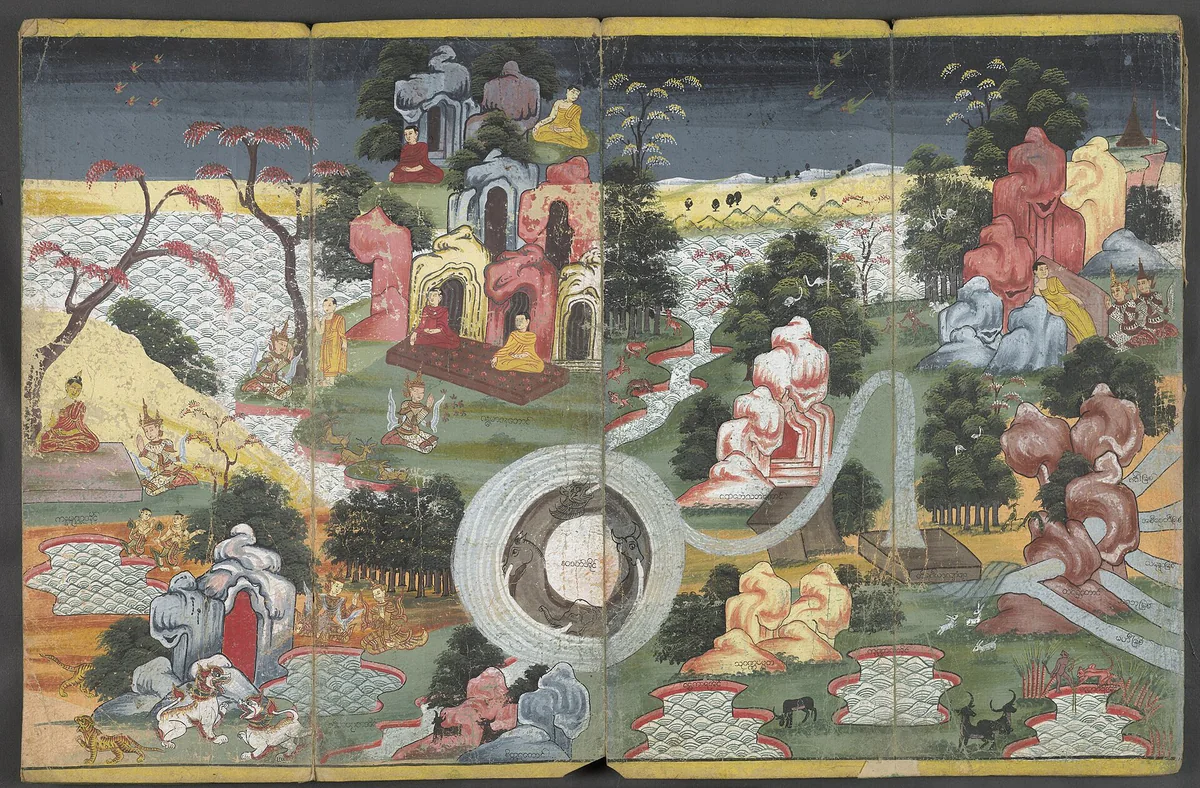
The public-domain Walters painting is a later Thai visual witness. It makes a specific art-historical form visible: a human-bird figure in a landscape.
It does not establish that every Pāli or Chinese kinnara looked the same. Its caption records collection, date, and limit.
A better habitat answer
Instead of saying “Kinnari lives in Himmapan” as if that settled every source, the site says a kinnara/kinnari may be placed in several witness-specific mountain and forest settings.
That answer opens a richer path into Jātaka worlds, Chinese translations, and Thai manuscript culture.
Evidence ledger
Claims you can trace
These are the precise points supporting the guide. Each includes a claim type, source, locator, and limit.
Current evidence status
Kinnari / Kinnara is classified as Source-led guide.
Locator: Creature provenance ledger
Does not establish: The guide still separates named sources and images by witness.
What not to carry forward
- The name does not authorize one anatomy or habitat across traditions.
- Every visual example must be labeled with its own object and date.
Sources
Read the evidence layer
Jātaka-aṭṭhakathā narrative geography audit
Ja 514 (Chaddanta), Ja 536 (seven lakes), Ja 485 and Ja 504 (kinnara settings)
Narrative landscapes are held as their own family so individual stories cannot silently rewrite the Samantapāsādikā baseline.
Boundary: A landscape in one Jātaka is not automatically a universal Himavanta layout.
Chinese Buddhist Anavatapta source family
T23, T24, T25, T197, T199, T2087; History 04 source manifest
Translations and Xuanzang/Bianji’s record create witness-specific Kunlun, river, mountain, and animal-direction configurations.
Boundary: Source-reported geography is not a modern field survey and does not erase other variants.
Berlin Traiphum II 650 research record
Anotatta at fols. 35v–36v; six-metre public project section
An eighteenth-century Thonburi cosmogram with an object-specific animal-direction arrangement.
Boundary: The surviving manuscript’s relationship to the 1776 commission remains disputed; this site does not reproduce unlicensed imagery.
Open source ↗Later Thai Himmapan creature provenance ledger
History 09 Gate 1/2 creature provenance and corpus controls
The ledger separates court procession, royal crematorium, architectural, Lanna funeral, and later catalogue traditions.
Boundary: A later creature catalogue does not establish an early textual habitat or a universal ancient taxonomy.
Continue through the archive
Related guides
Start here
What Is the Himmapan Forest?
A clear, illustrated introduction to Himavanta / Himmapan: a changing Buddhist mountain, forest, and sacred-water world.