Source-led guide
Chaddanta
Buddhist narrative
Chaddanta is recorded here as the six-tusked elephant king and dense narrative geography of chaddanta lake must be distinguished from generic elephant imagery. Its current status is source-led guide: the page distinguishes a source-led guide from a later visual-index identification rather than inventing an ancient universal biography.
_-_Walters_35265_-_A_T_Front.jpg)
What this page does
One source family at a time
This guide links each major assertion to a named source and a boundary. It is designed to be useful for readers, artists, teachers, and researchers without pretending that later images can repair earlier silence.
The six-tusked elephant king
Chaddanta is a named narrative figure, not a generic elephant. In Ja 514, the elephant king presides over a vast, carefully described lake kingdom.
Its fifty-by-fifty yojana scale, seven mountain rings, vegetation, banyan, cave, and seasonal elephant movements make it one of the most detailed early Pāli landscapes in the archive.
A geography with its own rules
Chaddanta’s landscape belongs to its Jātaka. It should not be treated as an interchangeable map of Anotatta simply because both are situated within broad Himavanta imagination.
The medieval Sāratthadīpanī also has a Chaddanta subsection, but the audit identifies a separate explicit dependency on Chaddantajātaka commentary.
Why elephant imagery is not enough
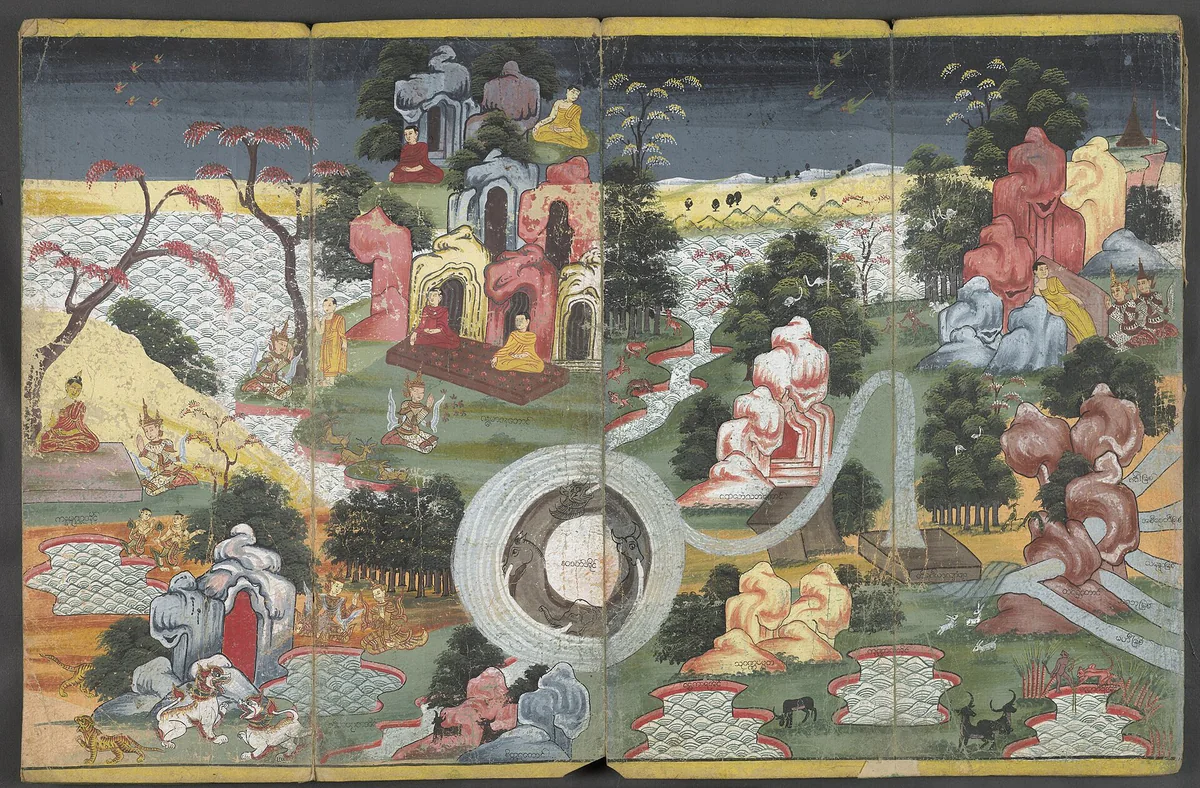
The Thai painting shown here is a public-domain Vessantara Jātaka image, not a Chaddanta illustration. It gives visual context for Thai narrative forest painting while the caption prevents false identification.
The site will add a Chaddanta-specific public-domain visual only after a suitable object and reuse record are reviewed.
Evidence ledger
Claims you can trace
These are the precise points supporting the guide. Each includes a claim type, source, locator, and limit.
Current evidence status
Chaddanta is classified as Source-led guide.
Locator: Creature provenance ledger
Does not establish: The guide still separates named sources and images by witness.
What not to carry forward
- The name does not authorize one anatomy or habitat across traditions.
- Every visual example must be labeled with its own object and date.
Sources
Read the evidence layer
Jātaka-aṭṭhakathā narrative geography audit
Ja 514 (Chaddanta), Ja 536 (seven lakes), Ja 485 and Ja 504 (kinnara settings)
Narrative landscapes are held as their own family so individual stories cannot silently rewrite the Samantapāsādikā baseline.
Boundary: A landscape in one Jātaka is not automatically a universal Himavanta layout.
Sāratthadīpanī Gate 2 controlled extraction
Vol. 1 p. 94; Vol. 3 p. 157; bounded occurrence and claim ledgers
This medieval Vinaya subcommentary contains the largest connected Anotatta drainage dossier in the audited Pāli-area material.
Boundary: The exposition is compilational/inherited in parts and is not a surveyed watershed.
Continue through the archive
Related guides
Start here
What Is the Himmapan Forest?
A clear, illustrated introduction to Himavanta / Himmapan: a changing Buddhist mountain, forest, and sacred-water world.