Object / Historical object, Scholarly interpretation, Project synthesis
The Berlin Traiphum Manuscript
The Berlin Traiphum is a spectacular late Thai visual witness. It can anchor public explanation, but only within the folios and specialist evidence actually reviewed.
What this page establishes: The manuscript is invaluable because it shows a later Thai Himavanta world as a visual field; it is not a universal key to every earlier source.
Why this manuscript belongs on the homepage
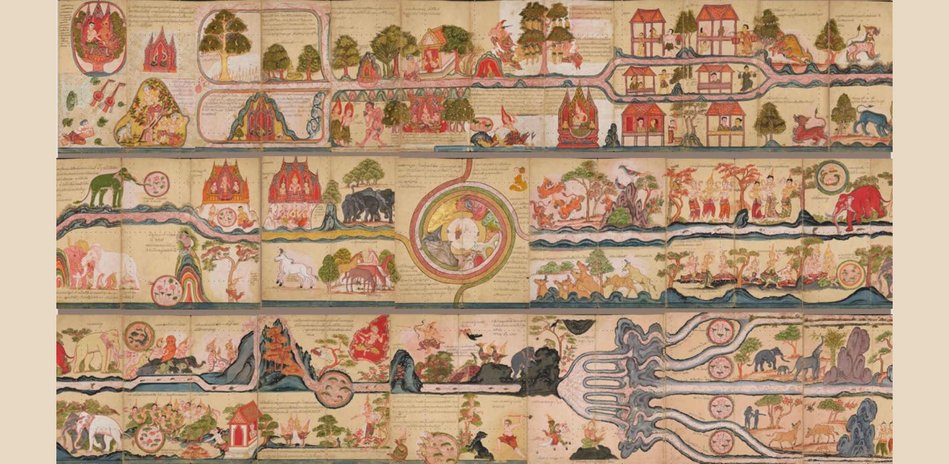
The public museum images are the strongest visual assets available for launch. They show Himavanta not as a blank mythic forest but as an organized scene of water, trees, creatures, buildings, labels, and cosmographic movement.
For visitors, that image does more in one glance than a page of abstract caveats. It makes the world visible while the caption keeps the evidence bounded.
What has to stay limited
Only the public images and the specialist article are safe for the current public site. The complete manuscript remains outside this site layer unless its folios, captions, and sequence are transcribed and reviewed separately.
That is why the site should say "visual witness" rather than "complete manuscript reconstruction." The first is true; the second is not yet done.
How to read the images
The six-metre collage is useful for explaining scale and density. The Anotatta double-folio is useful for explaining sacred-water organization and animal imagery. Both should be credited visibly and linked back to the source page.
Their role is to make the research legible, not to decorate unrelated topics.
Evidence notes
- Use the two public images with visible museum credit.
- Do not claim full Berlin manuscript review unless the folios are actually transcribed and checked.
- Use the images primarily on Thai cosmography, Anotatta, creature, and method pages.
Sources and boundaries
The complete Berlin manuscript is not yet a fully reviewed public corpus in this workspace.
-
Historical object
Staatliche Museen zu Berlin, Museum fuer Asiatische Kunst, six-metre Traiphum research page
Direct public manuscript image records used by this site
The images are treated as late Thai visual evidence, not as automatic proof for all earlier textual traditions.
-
Scholarly interpretation
Martina Stoye and Panarut Rungrueng, "In den seligen Gefilden des Himavanta"
Open-access article with Berlin Traiphum manuscript images
Supports the public use of the Berlin manuscript images as a bounded visual witness.
-
Project synthesis
Himavanta cross-history research archive
histories/ plus history-09 gate records; source families frozen independently
Used only as a synthesis layer. It cannot promote a later witness into an earlier source family.